

Why skills like curiosity, empathy and judgment matter more as technology gets smarter
As we navigate an increasingly automated and AI-driven world, the value of a liberal arts education is more relevant than ever.
About 25 years ago, I earned my degree in economics. To me, this field has always been centered on understanding how people make decisions. Graduating during the dot-com boom, I entered the tech consulting field despite my liberal arts background. Initially, I didn’t understand why I would be valuable to technology projects, but over time, it became very clear.
Now, as the leader of a digital transformation consulting firm that helps organizations implement technology and artificial intelligence, I’ve realized that the skills I use most aren’t technical at all. They stem from my liberal arts foundation.
If I had to sum it up, there are three key lessons from studying the liberal arts that are more essential today than ever before.
Ask better questions
The first lesson is to learn to ask better questions.
Technology can generate answers instantly, but it doesn’t know what questions matter. I see this all the time in my work.
Recently, we worked with a client who had invested millions of dollars in a technology platform. From a technical standpoint, it worked exactly as designed. However, their sales and marketing teams weren’t using it.
The instinct was to focus on the system, adding more features, more training, and more enforcement. But when we stepped back and asked better questions, we uncovered something very different. There was no real incentive for anyone to use the system until the very end of the sales process, leaving leadership with no visibility into the pipeline, no ability to forecast, and no way to plan. So, deals would either show up unexpectedly…or not at all.
The issue wasn’t the technology; it was how the system aligned, or failed to align, with human behavior and incentives. Once we reframed the problem that way, the solution became much clearer. For me, that experience reinforced that the most important work isn’t always in the answer — it’s in asking the right questions from the start.
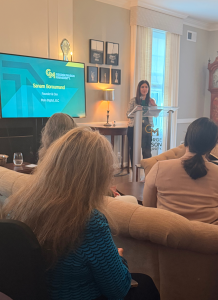
Main Digital CEO Sanam Boroumand addresses a local college audience on the value of a liberal arts education.
Develop empathy and perspective
The second lesson is to develop empathy and perspective.
The ability to truly understand how other people experience a system — not how we think they should, but how they actually do. Most technology doesn’t fail because of code — it fails because it doesn’t fit how people work, what motivates them, or what they’re measured on.
What I’ve learned is that without empathy, we design systems for logic. With empathy, we design systems for reality. That shift, from thinking about the system to thinking about the experience, often determines whether something succeeds or fails.
And that ability to step into someone else’s perspective is something I use constantly. I also directly attribute it to my liberal arts education.
Exercise judgment, especially in ambiguity
The third lesson is to exercise judgment, especially in ambiguous situations.
AI is incredibly powerful, but it doesn’t carry accountability. It can generate recommendations, but it doesn’t understand context, trade-offs, or consequences the same way.
Therefore, the role of leaders today isn’t just to use technology; it’s to question it, interpret it and decide what to do with it. Increasingly, the risk isn’t that machines get it wrong; it’s that we stop questioning them.
Human skills matter more than ever
In an era defined by incredibly smart machines, it’s tempting to think that technical skills are all that matter. But my experience has shown me otherwise. The ability to ask better questions, develop empathy and perspective and exercise sound judgment has only grown more valuable as technology advances. These are precisely the strengths that a liberal arts education cultivates.
As we continue to embrace new technologies, it’s worth remembering that our most human qualities, those rooted in curiosity, understanding and thoughtful decision-making, are what truly set us apart. In the end, these skills will not only help us keep pace with change, but also lead it.
Contributed by Sanam Boroumand