
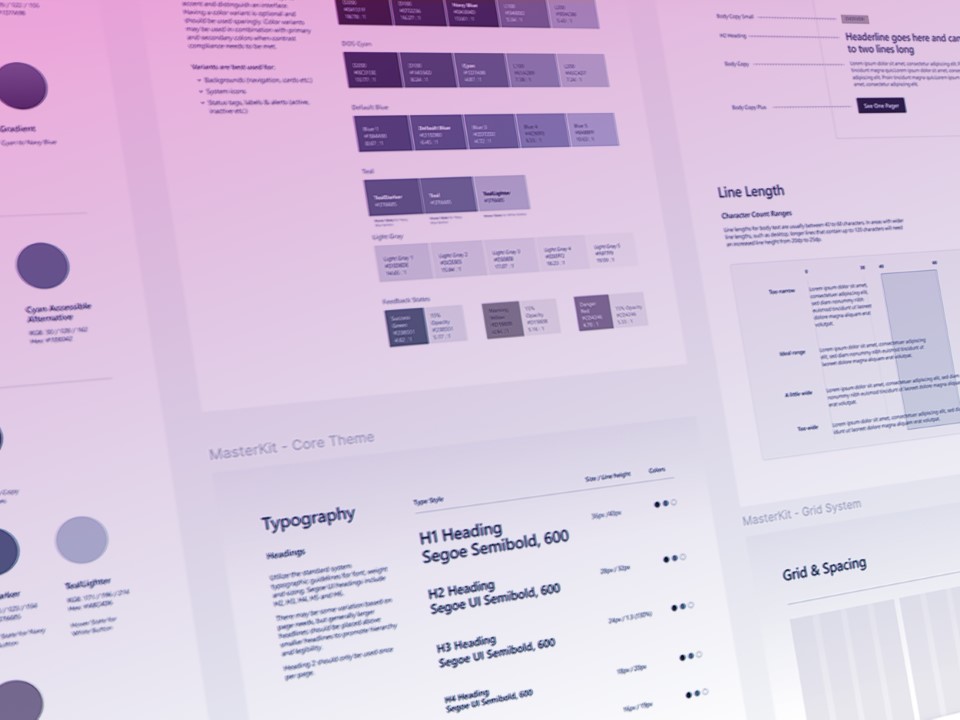
A well-executed design system can fuel faster production, better user experiences and tighter team alignment.
Delivering seamless and consistent user experiences across all your products is essential. Yet, for organizations with a sprawling network of websites and applications, maintaining that consistency can feel impossible. That’s where a robust design system comes in. By investing in a well-crafted design system, you empower your teams to work faster, collaborate better and create digital experiences that feel unified and user-friendly.
In this post, we share how we helped a client transform their complex digital ecosystem into a cohesive, scalable, and brand-aligned powerhouse, and discuss the benefits a design system can bring to your organization.
The Problem
Our client came to us with a complex and sprawling network of digital products—some were websites, others were applications, and many fell somewhere in between. It was a digital ecosystem built over decades, and it showed. Across the organization, employees jumped between these disconnected platforms daily—each one its own isolated experience with unique navigation, design elements and workflows.
Not only did these products differ wildly from one another, but many were also inconsistent within themselves. As you can imagine, this led to a fragmented brand presence, a disjointed user experience, and a maintenance nightmare, making updates and enhancements slow and difficult to manage.
Our Approach
We created a comprehensive design system and component library that defined all branded elements—logos, colors, typography and more—and documented how these elements should be applied to user interface (UI) components and user experience (UX) patterns. The goal was to build a system that functions like a LEGO set, allowing the client’s websites and applications to be assembled piece by piece with consistency and ease.
Since the client’s digital products were initially built on a wide range of platforms, including several Microsoft tools, we began by aligning with Microsoft’s Fluent Design System. This was especially impactful for their SharePoint sites and has since extended to other applications and platforms.
The result has been a significantly more cohesive digital ecosystem, with a unified brand and user experience, faster design and development, smoother collaboration, and a framework that supports long-term scalability and easier maintenance. When you invest in developing your Design System, you can look forward to gaining the following benefits:
Consistent User Experience
Design systems make it much easier to deliver a consistent user experience. By using the same visual language—things like buttons, typography, spacing and colors—across all platforms, everything feels familiar and predictable for users. That means less confusion, smoother navigation and an overall better experience.
Plus, many design systems include accessibility guidelines from the start, allowing you to support a more inclusive audience without extra effort.
Consistent Brand Experience
A strong design system also helps keep your brand identity rock solid. Elements like logos, colors, fonts and tone of voice all stay aligned with your brand guidelines, no matter where they show up.
Whether you’re designing a mobile app or a marketing page, the brand feels cohesive, even as your product grows across different platforms or markets. It’s a great way to build and maintain trust with your audience.
Faster Design and Development
One of the biggest wins with a design system is speed. With a library of ready-to-use components, designers and developers can skip reinventing the wheel and move straight to building. It’s perfect for rapid prototyping and testing new ideas fast.
Since everyone is using the same components, updates or fixes only need to be made once—they’ll automatically apply everywhere else.
Improved Collaboration
Design systems create a shared language that brings designers, developers, product managers and others onto the same page. That shared understanding reduces confusion and helps teams work more efficiently together. It also makes onboarding new team members easier, since everything is documented and clear. By bridging the gap between design and code, these systems make cross-functional teamwork much smoother.
Scalability and Maintainability
Maintaining a growing product is a lot simpler with a design system in place. When you update a component or design token, that change instantly applies wherever it’s used, keeping everything consistent without extra effort. It also makes scaling much easier, helping your team grow the product without piling up design or tech debt along the way.
Enhanced Quality and Testing
Design systems can seriously boost product quality. Since components are reused and already tested, there’s less chance of bugs and greater overall stability. On top of that, having clear documentation makes it easier for quality assurance (QA) teams to understand how things should look and behave, thereby speeding up the testing process and improving accuracy.
Summary
In summary, a well-executed design system is not just a style guide; it’s a living ecosystem that fuels faster production, better user experiences, and tighter team alignment. It’s a foundational investment that pays dividends across the lifecycle of a product and brand.
We’d love to help you build out your Design System. Contact our talented team to get started!
Contributed By: Sarita Loredo